Problem 15 (trigonometry): Always observe the answer options before you start to work on a problem. For example, if the answer options show bounds, then don’t go ahead and try to calculate the actual value. Problem 16 (circles): Descartes’ Circle Theorem states that $2(a^2 + b^2 + c^2 + d^2)=(a+b+c+d)^2$,…
Math
AMC 12B 2018 Notes
Problem 8 (centroids): Given points $(a,b)$, $(c,d)$, and $(e,f)$ on the coordinate plane, the coordinates of the centroid are $(\frac{a+c+e}{3},\frac{b+d+f}{3})$. Problem 11 (divisibility): READING THE QUESTION MULTIPLE TIMES WON’T HURT. More time would be wasted just guessing around the the problem meant. Problem 13 (centroids): Centroids of a triangle will…
AMC 12A 2018 Notes
Problem 11 (paper folding): When doing problems about folding something, just draw a perpendicular line across the midpoint and that is the line of reflection. Problem 15 (symmetry): Always consider symmetry, but also consider the edge cases too. Problem 17 (area geometry): Not everything is as it seems! Also, don’t…
AMC 12B 2019 Notes
Problem 10 (2 x 3 graph theory): Problems rarely make you just brute force everything out. Analyze the situation, come up with anything you can think of that makes progress. Problem 15 (Finding area): Consider your options. Don’t be set on one method or idea for a problem. Problem 17…
Lemma Inequality For The Sum of Cubes of Two Terms
Lemma. If $a, b \geq 0$, then $a^3 +b^3 \geq a^2 b + a b ^ 2$. Proof. Since $a,b\geq 0$, $a+b\geq 0$. Also, by the trivial inequality, $(a-b)^2 \geq 0$. Thus, $(a-b)^2 (a+b)\geq 0$. Expanding, $a^3 + b^3 – a^2 b – a b^2 \geq 0$. So, $a^3 +…
Math Formulas
$(a-b)^3=a^3-3a^2 b+3a b^2-b^3$ (remember the 3’s) $(a+b)^3=a^3+3a^2 b+3a b^2+b^3$ (remember the 3’s) $1^2 + 2^2 + … + n^2 = \frac{n(n+1)(2n+1)}{6}$ $1^3 + 2^3 + … + n^3 = \frac{n^2 (n+1)^2}{4}$ $\sum_{n=1}^{\infty} \frac{1}{n^2} = \frac{\pi^2}{6}$ For an $m \times n$ grid of numbers satisfying: let $a_{i,j}$ = the entry in…
Arithmetic Sequence Problem
If $p, q$ are distinct natural numbers, and in an arithmetic sequence {${a_n}$}, $S_p = S_q$, where $S_k$ denotes the sum of the first $k$ terms of the sequence {${a_n}$}. Prove that $S_{p+q}=0$. The formula for an arithmetic series is $S_n = n a_1 + \frac{n(n-1)}{2}d$. So, $S_p = p a_1+ \frac{p(p-1)}{2}d$ and $S_q = q a_1+ \frac{q(q-1)}{2}d$. Since $S_p…
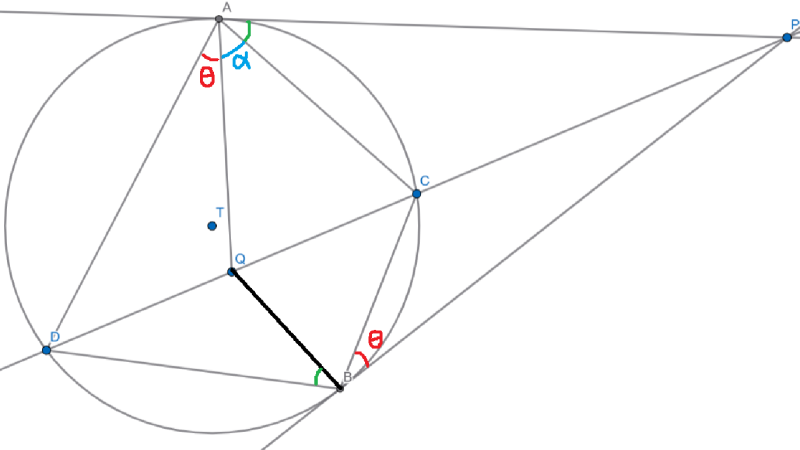
CMOQR 2026 P3
Problem: Let point $P$ be outside circle $\Gamma$. The tangents from $P$ to $\Gamma$ hit $\Gamma$ at $A$ and $B$. A third line through $P$ hits $\Gamma$ at $C$ and $D$, such that $C$ is between $P$ and $D$. Point $Q$ is on chord $CD$ such that $\angle DAQ$ =…
Algorithm for Finding Primes
Using brute force isn’t particularly the best solution when it comes to determining primes. Brute Force Example: Sieve of Eratosthenes: This method tries all the numbers, but as soon as a prime number is found all the multiples of it is marked as not prime, meaning there are less options…