Problem 16 (3D Geometry): 3-4-5 triangles are very important! These right triangles will most likely simplify a lot of calculations when used correctly. For this problem, I was unable to solve it because I didn’t use one of the 3-4-5 triangles as the base.
Problem 23 (probability): If something is hard to calculate then see if it is possible to split into casework. Throughout different cases, some factors will be simplified, making the problem easier to solve. For this problem, I didn’t do casework depending on the side of the second point, which made the general equation very complicated.
Problem 24 (probability): Steps shouldn’t be simplified just because they can. For example, When simplifying $cos^2 (a \pi)-sin^2 (b \pi)=0$, factoring it as a difference of squares will make solving this problem more complicated since then there will be 2 different cases to consider, whereas by keeping it as it is, we just need to have $cos(a \pi)$ and $sin(b \pi)$ to have the same magnitude. A way to realize that something is probably wrong is when you end up brute-forcing through tons of cases (this is what happens when you go through with factoring the difference of squares). When this happens, reconsider every step up to that point.
Problem 25 (tangent circles): Consider the configuration below.
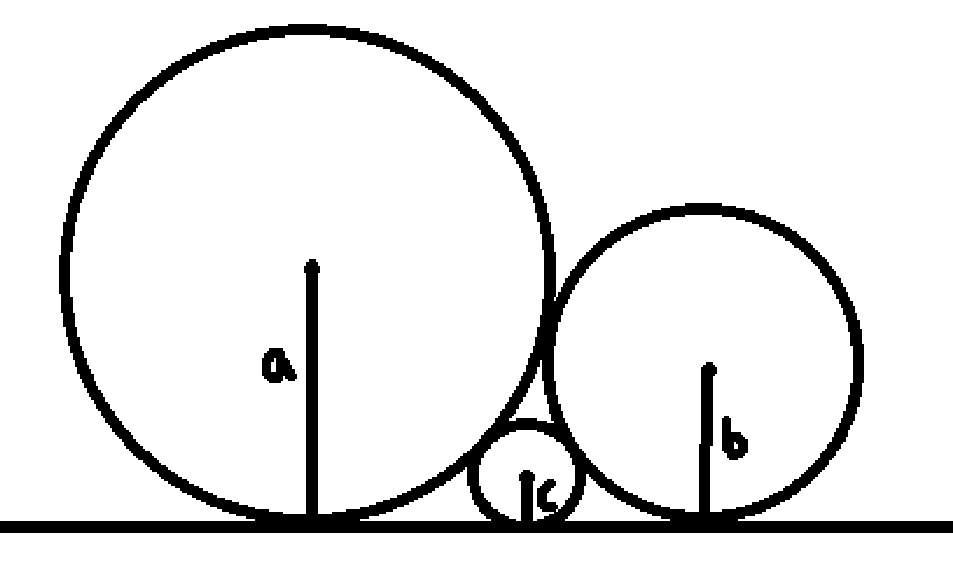
Then $\frac{1}{\sqrt{c}}=\frac{1}{\sqrt(a}}+\frac{1}{\sqrt(b)}$. Calculating layers for this problem is easier to calculate in this form, because the summation is of that form. Below are two different proofs of this formula:
Proof 1:
First consider these triangles:
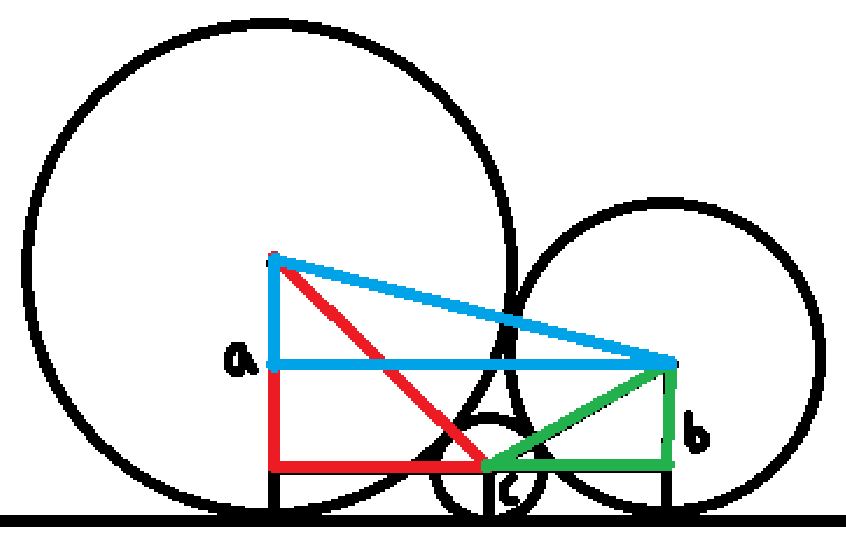
We will make the following calculations:
Proof 2:
Using Descartes’ Circle Theorem, we see that:
Now, for simplicity, let $x=\frac{1}{a}$, $y=\frac{1}{b}$, and $z=\frac{1}{c}$. Then,
Here’s another form of the Descartes’ Circle Theorem: $d=a+b+c \pm 2 \sqrt{ab+bc+ca}$