Problem:
Let point $P$ be outside circle $\Gamma$. The tangents from $P$ to $\Gamma$ hit $\Gamma$ at $A$ and $B$. A third line through $P$ hits $\Gamma$ at $C$ and $D$, such that $C$ is between $P$ and $D$. Point $Q$ is on chord $CD$ such that $\angle DAQ$ = $\angle PBC$. Prove that $\angle DBQ$ = $\angle PAC$.
Solution Sketch:
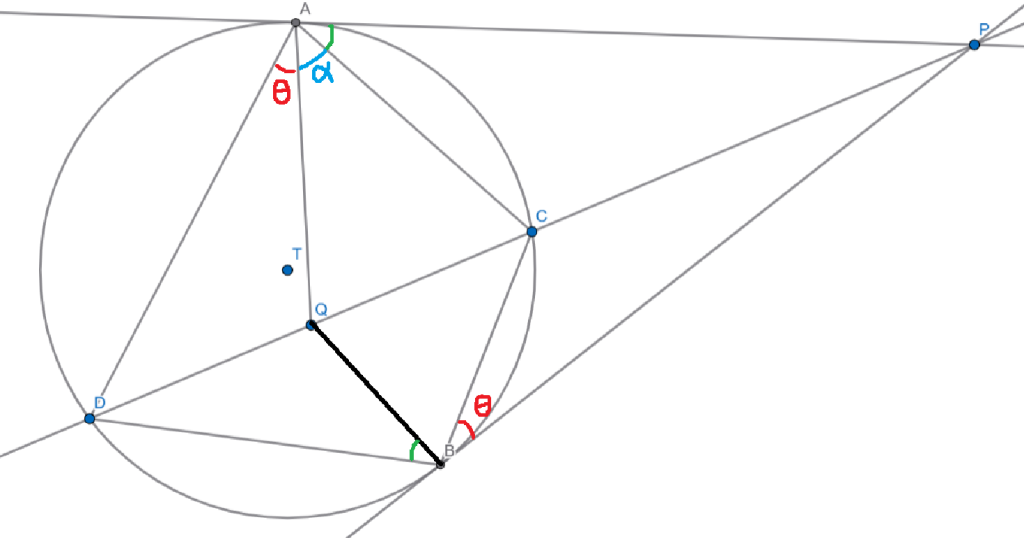
We will try to find $\frac{DQ}{CQ}$ in a way that does not depend on $Q$. First, note that $\sin(\angle AQD) = \sin(\pi – \angle AQC) = \sin(\angle AQC)$. Let $\theta = \angle DAQ = \angle PBC$ and $\alpha = \angle QAC$. By the sine law on $\triangle AQC$, $\frac{\sin(\angle \alpha)}{CQ} = \frac{\sin(\angle AQC)}{AC}$, so $CQ = \frac{AC \sin(\angle \alpha)}{\sin(\angle AQC)}$. Similarly, by the sine law on $\triangle AQD$, $\frac{\sin(\angle \theta)}{DQ} = \frac{\sin(\angle AQD)}{AD}$, so $DQ = \frac{AD \sin(\angle \theta)}{\sin(\angle AQD)}$. $\sin \angle AQD = \sin\angle AQC$, so $DQ = \frac{AD \sin(\angle \theta)}{\sin(\angle AQC)}$. Thus, $\frac{DQ}{CQ} = \frac{AD \sin \theta}{AC \sin \alpha}$.
We will now find terms that represent $\sin \theta$ and $\sin \alpha$. First, note that since $A$, $B$, $C$, and $D$ are concyclic, then $\angle DAQ + \angle DBC = \pi$. This means that $\angle QAC = \alpha = \angle PDB$. By the sine law on $\triangle PCB$, $\frac{\sin \angle DPB}{BD} = \frac{\sin \alpha}{DP}$, so $\sin \angle \alpha = \frac{DP \sin \angle DPB}{BC}$. By the sine law on $\triangle PDB$, $\frac{\sin \angle \theta}{PC} = \frac{sin \angle DPB}{BC}$, so $\angle \theta = \frac{PC \sin \angle DPB}{BC}$.
We now see that $\frac{DQ}{CQ} = \frac{AD \sin \theta}{AC \sin \alpha}$ becomes $\frac{DQ}{CQ} = \frac{AD \frac{PC \sin \angle DPB}{BC}}{AC \frac{DP \sin \angle DPB}{BC}} = \frac{AD \cdot BC \cdot PC}{AC \cdot BC \cdot PD}$. Notice that this is symmetric in $A$ and $B$, so if we pick a point $Q’$ such that $\angle PAC = \angle DBQ’$, then $\frac{CQ’}{DQ’} = \frac{CQ}{DQ}$, so $Q = Q’$. Therefore, $\angle DBQ = \angle PAC$. $\square$