If $p, q$ are distinct natural numbers, and in an arithmetic sequence {${a_n}$}, $S_p = S_q$, where $S_k$ denotes the sum of the first $k$ terms of the sequence {${a_n}$}. Prove that $S_{p+q}=0$. The formula for an arithmetic series is $S_n = n a_1 + \frac{n(n-1)}{2}d$. So, $S_p = p a_1+ \frac{p(p-1)}{2}d$ and $S_q = q a_1+ \frac{q(q-1)}{2}d$. Since $S_p…
Month: March 2026
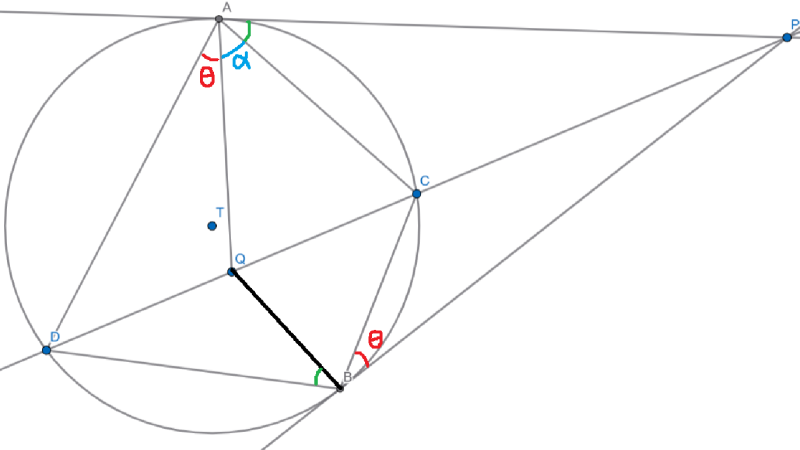
CMOQR 2026 P3
Problem: Let point $P$ be outside circle $\Gamma$. The tangents from $P$ to $\Gamma$ hit $\Gamma$ at $A$ and $B$. A third line through $P$ hits $\Gamma$ at $C$ and $D$, such that $C$ is between $P$ and $D$. Point $Q$ is on chord $CD$ such that $\angle DAQ$ =…
Diameter And Radius Of A Tree
In Graph Theory, the diameter of a tree is the largest distance between any two points. The radius is the minimum distance of the maximum distance of any node on the of the diameter to one of the two diameter endpoints. Take the following graph as an example. In this…